What is risk-based auditing? Methods, benefits, and insights


TL;DR:
Risk-based auditing prioritizes resources based on current threat levels rather than fixed schedules.
Continuous risk assessment and technological tools enhance audit effectiveness and adapt to changing risks.
Successful RBA requires ongoing reassessment, cross-functional collaboration, and integration of AI and data analytics.
Most audit functions still run on a fixed annual calendar. The schedule feels orderly, but it creates a dangerous illusion of coverage. Risks don’t wait for your next scheduled review, and the gaps between cycles can quietly widen into material exposures. Risk-based auditing (RBA) breaks that pattern by directing resources where threats are actually greatest, not where the calendar points. This guide explains what RBA is, how it differs from traditional auditing, what the process looks like in practice, and where the methodology is heading. Whether you’re refining your current program or building one from scratch, these principles will sharpen how you protect your organization.
Table of Contents
Understanding risk-based auditing: Core concepts and definitions
The risk-based auditing process: Steps, best practices, and pitfalls
Benefits, limitations, and evolving trends in risk-based auditing
Practical integration: Tools, technologies, and future directions
Why most organizations misuse risk-based auditing—And how to fix it
Key Takeaways
Point | Details |
Dynamic risk prioritization | RBA replaces fixed audit schedules with flexible, risk-driven decision making. |
Process clarity | The RBA process cycles through universe definition, risk scoring, prioritization, and continuous updating. |
Measurable benefits | Empirical evidence links RBA to financial improvement and higher audit quality. |
Technology evolution | AI and analytics boost RBA effectiveness but require ongoing adaptation and training. |
Common pitfalls | Model subjectivity and outdated frameworks can limit RBA success if not addressed proactively. |
Understanding risk-based auditing: Core concepts and definitions
Now that we’ve established why traditional audit cycles may leave organizations exposed, let’s clarify what risk-based auditing really means.
Risk-based auditing is an approach that allocates audit effort according to the relative risk level of each area within an organization. Instead of rotating through every business unit on a fixed schedule, RBA continuously evaluates where the greatest threats to objectives exist and focuses attention there first. It draws directly from enterprise risk management principles, treating the audit plan as a living document rather than a static checklist.
Three foundational concepts anchor the methodology:
Audit universe: The complete inventory of auditable entities, including processes, systems, business units, and controls. Think of it as your map before you decide which roads to inspect.
Risk scoring: A structured method for rating each entity by likelihood and impact of risk materialization. Scores can incorporate financial exposure, regulatory sensitivity, operational complexity, and historical findings.
Prioritization: The output of scoring. High-risk areas receive frequent, in-depth reviews; lower-risk areas receive lighter or less frequent coverage.
The critical insight is that RBA replaces fixed audit cycles with dynamic, risk-prioritized assessments. That shift sounds simple, but it demands a fundamentally different mindset from audit leadership and staff alike.
Many teams struggle because they graft RBA language onto traditional processes without changing how they actually plan work. They score risks once a year, file the results, and proceed with the same rotation they always used. That’s not risk-based auditing. That’s risk-based labeling.
Understanding risk assessment steps in detail is essential before you can build a credible RBA program. The assessment phase is where the quality of your entire plan is determined.
“The value of risk-based auditing is not in the framework you adopt—it’s in the quality of judgment applied at every step.”
Pro Tip: Resist the checkbox mindset. A risk score is a starting point for professional judgment, not a substitute for it. Always ask whether the scoring reflects current conditions, not last year’s assumptions.
For a broader view of how RBA applies across industries, risk-based auditing in financial services offers useful context on how regulated sectors operationalize these principles.
RBA versus traditional auditing: Key differences
With those principles defined, it’s important to see exactly how risk-based auditing differs in practice from traditional models.
RBA contrasts with traditional auditing by prioritizing based on risk rather than schedule. That single distinction cascades into nearly every aspect of how audits are planned, resourced, and reported.

Feature | Traditional auditing | Risk-based auditing |
Scheduling | Calendar-driven rotation | Risk-priority driven |
Scope | Predetermined, fixed | Dynamic, adjusted to risk |
Resource allocation | Spread evenly | Concentrated on high-risk areas |
Frequency | Annual or periodic | Continuous or event-triggered |
Stakeholder alignment | Compliance-focused | Objective and strategy-focused |
Adaptability | Low | High |
The practical stages also differ. Traditional audits typically follow a linear path: plan, fieldwork, report, repeat. RBA adds a continuous reassessment loop that feeds new risk intelligence back into the planning phase before the next cycle begins.
Here’s how a mature RBA function structures its work:
Conduct a risk universe assessment at least quarterly, not annually.
Adjust audit priorities based on emerging risks, regulatory changes, and operational shifts.
Allocate resources proportionally, heavier coverage where risk scores are highest.
Report findings with explicit linkage to risk impact, not just control deficiencies.
Feed results back into the risk scoring model to improve future prioritization.
Regulatory pressure is also accelerating RBA adoption. Frameworks from the IIA, PCAOB, and sector-specific regulators increasingly expect audit functions to demonstrate risk-responsive planning. Organizations that still operate on pure calendar cycles face growing scrutiny during regulatory examinations.
“An audit plan that doesn’t reflect your current risk environment isn’t a plan. It’s a schedule.”
Exploring continuous auditing advantages alongside RBA reveals how the two approaches reinforce each other, particularly when technology enables real-time data monitoring. The regulatory drivers for RBA are worth reviewing if your organization operates in a heavily regulated sector.
The risk-based auditing process: Steps, best practices, and pitfalls
Understanding the differences is only half the story. Next, let’s explore how risk-based auditing actually unfolds in real organizations.
The RBA process follows a cycle: define the audit universe, conduct risk identification and assessment, prioritize, execute audit planning and fieldwork, then report and follow up. That cycle then feeds back into itself.
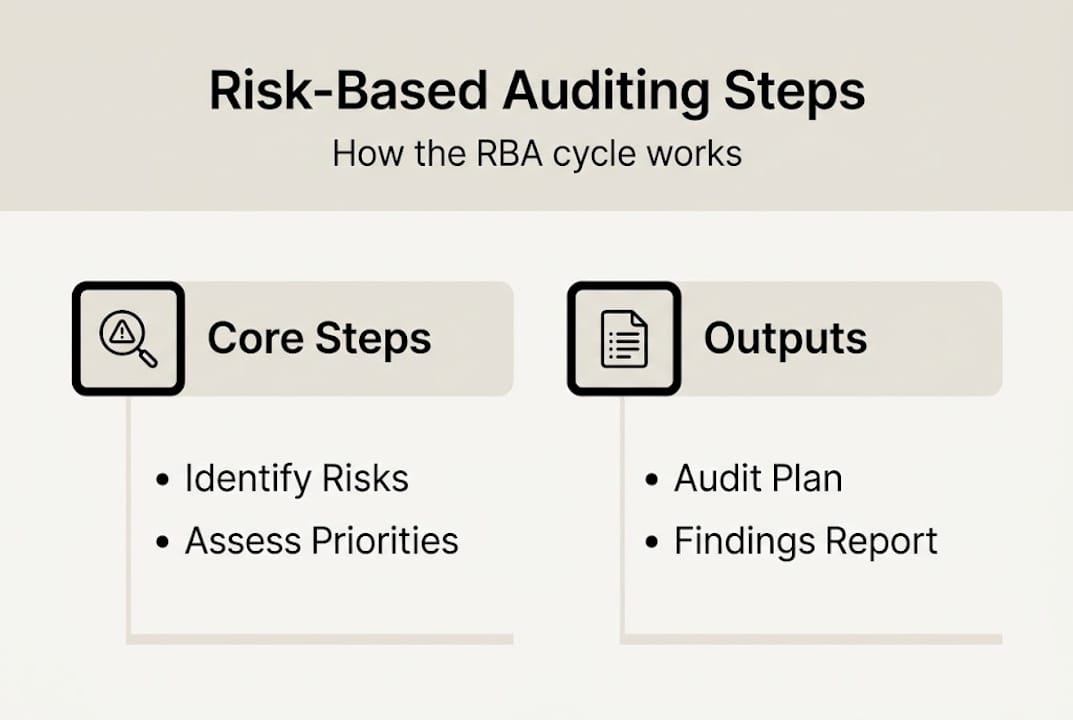
Step | Key activity | Output |
1. Define audit universe | Catalog all auditable entities | Complete entity inventory |
2. Risk identification | Assess likelihood and impact | Risk register |
3. Prioritization | Score and rank entities | Ranked audit plan |
4. Planning and execution | Conduct fieldwork on high-risk areas | Audit findings |
5. Reporting and follow-up | Communicate results, track remediation | Closed findings, updated scores |
Several pitfalls appear repeatedly in practice. Subjective scoring is the most common. When risk ratings depend heavily on a single auditor’s judgment without structured criteria or cross-functional input, scores drift and lose credibility. Coverage gaps are another concern. If low-risk entities are never audited, you may miss slow-building risks that haven’t yet triggered a high score.
Detailed audit planning steps can help teams build the structure needed to avoid these traps. Pairing that with solid risk assessment for auditors methodology strengthens the entire process.
For additional RBA process details specific to regulated industries, external guidance can supplement internal frameworks effectively.
Pro Tip: Use multi-dimensional scoring that incorporates financial exposure, regulatory impact, operational complexity, and historical findings. Then validate scores with input from business unit leaders, legal, and compliance. One perspective is never enough.
Benefits, limitations, and evolving trends in risk-based auditing
With those steps and potential pitfalls explained, it’s crucial to weigh what RBA delivers and where it can still fall short.
Key benefits of RBA include:
Improved audit quality through focused, deeper coverage of material risk areas
Better alignment with organizational strategy and regulatory expectations
More efficient use of limited audit resources
Stronger credibility with boards and audit committees who expect risk-responsive reporting
Faster identification of emerging threats before they become material losses
The financial evidence is compelling. Research shows improved financial performance and audit quality, with machine learning models reaching F1-scores up to 0.9012 for risk prediction. That level of accuracy in identifying high-risk entities represents a significant leap beyond what manual scoring alone can achieve.
The numbers on organizational outcomes are equally striking. Studies have documented profit improvements exceeding 65% in organizations that fully implement risk-responsive audit programs, driven by earlier detection of control failures and reduced remediation costs.
But RBA is not without real limitations. Expert critiques call for a shift from periodic to agile auditing and flag model subjectivity and coverage limitations as emerging issues. When risk models are built on stale data or narrow assumptions, they can systematically underweight certain threat categories.
Dynamic risk environments compound this problem. Geopolitical shifts, cyber threats, and supply chain disruptions can invalidate a risk model within weeks. An annual reassessment cycle simply cannot keep pace.
The trends addressing these gaps are significant. AI in audit is enabling continuous risk monitoring at a scale no human team can match. Data analytics in auditing allows auditors to detect anomalies in real time rather than waiting for the next scheduled review. Adaptive frameworks that update risk scores automatically based on transaction data and external signals are moving from pilot programs into mainstream use.
The direction is clear: static RBA models are becoming a baseline, not a best practice. The ML in risk auditing research makes a strong case for integrating predictive tools into your current methodology.
Practical integration: Tools, technologies, and future directions
Finally, let’s turn theory into practice with guidance on what to do next, including how technology will shape the future of risk-based auditing.
As one expert perspective notes, traditional RBA models may be outdated by 2035 as next-generation risks require agile, continuous, and technology-enabled auditing practices. That’s not a distant concern. The groundwork needs to start now.
Here’s a practical roadmap for integrating technology into your RBA program:
Audit your current tools. Identify gaps between what your team uses today and what continuous risk monitoring requires. Most teams discover they’re still relying on spreadsheets for risk scoring.
Pilot a data analytics layer. Start with one high-risk process area. Connect transaction data to your risk scoring model and observe how scores shift in real time versus your annual review.
Adopt continuous risk monitoring platforms. Tools that ingest operational data, flag anomalies, and update risk registers automatically are now accessible to mid-sized audit functions, not just large enterprises.
Integrate AI for pattern recognition. AI tools for internal audit can identify risk clusters that manual review would miss, particularly in large transaction volumes or complex control environments.
Build feedback loops. Every audit finding should update the risk model. If a control failure wasn’t predicted by your scoring, understand why and adjust the model.
Pair RBA with continuous auditing methods. The two approaches are strongest together, with RBA setting priorities and continuous auditing providing the monitoring infrastructure.
Pro Tip: Technology adoption without team upskilling creates a false sense of security. Invest in training alongside tools. An auditor who doesn’t understand how an AI model generates risk scores cannot exercise the professional judgment needed to challenge or override it.
Why most organizations misuse risk-based auditing—And how to fix it
After addressing practical steps, it’s worth questioning some of the flawed mindsets that quietly undermine RBA’s potential.
The most common mistake we see is treating RBA as a project rather than a system. Organizations invest significant effort in building a risk universe, scoring entities, and producing a ranked audit plan. Then they execute that plan for twelve months without revisiting the underlying assumptions. That’s not risk-based auditing. That’s a risk-informed schedule, which is a much weaker thing.
Over-reliance on risk scores is equally damaging. When scores become the answer rather than a prompt for inquiry, auditors stop asking hard questions. The score says low risk, so the team moves on. But scores reflect the inputs you fed them. If those inputs were incomplete or biased, the score is wrong and you won’t know it until something breaks.
The most resilient audit functions we’ve observed share one trait: they treat risk reassessment as a continuous, cross-functional conversation, not an annual exercise. They involve operations, legal, IT, and finance in updating risk views regularly. They also understand the correct use of AI in auditing as an enabler of judgment, not a replacement for it.
The fix is cultural as much as technical. Build a team that challenges its own assumptions, welcomes new risk signals, and treats every finding as an opportunity to improve the model.
Take your risk-based auditing to the next level
Ready to move beyond the basics? The gap between understanding RBA conceptually and executing it with precision is where most audit functions stall. Targeted professional development closes that gap faster than any internal memo.
Compliance Seminars offers CPE-eligible training designed specifically for audit and compliance professionals who need to apply advanced RBA methodologies in real organizations. Browse our CPE event calendar for in-person sessions across multiple U.S. cities, or access focused internal auditor CPE webinars covering risk-based methods and compliance trends. For teams navigating AI adoption, our AI in audit training program builds the practical skills needed to lead technology-enabled audit functions with confidence.
Frequently asked questions
What is the main goal of risk-based auditing?
Risk-based auditing focuses audit resources on the areas with the highest risk exposure to improve effectiveness and catch significant threats early. Unlike fixed-cycle approaches, dynamic risk-prioritized assessments ensure coverage reflects current conditions rather than last year’s schedule.
What are common steps in the risk-based auditing process?
The core steps are defining the audit universe, risk identification and assessment, prioritization, audit planning and execution, and continuous reassessment. This five-step audit cycle is designed to loop back on itself so the plan stays current as risks evolve.
What are key limitations of risk-based auditing?
The main limitations are model subjectivity, coverage gaps in lower-risk areas, and difficulty keeping pace with rapidly changing risk environments. Coverage gaps and scoring dependency are particularly common in organizations that rely on annual rather than continuous risk reassessment.
How does technology impact risk-based auditing?
AI and data analytics significantly improve risk prediction accuracy, with ML models reaching F1-scores up to 0.9012, but they require continuous team upskilling and ongoing process adaptation to deliver reliable results.
Recommended
Comments