Master Risk Assessment for Auditors: A Step-by-Step Approach


Keeping pace with shifting regulatory pressures and evolving risks is a daily reality for auditors working with American financial institutions. Audits that only scratch the surface often miss compliance gaps or hidden threats that could jeopardize reputational trust and organizational stability. By mastering advanced risk assessment strategies, auditors can sharpen their focus, design more impactful audits, and confidently address the complexities of modern regulatory environments.
Table of Contents
Quick Summary
Key Insight | Explanation |
1. Define clear audit objectives | Establishing clear audit objectives is crucial for effective compliance assessment and targets relevant areas accurately. |
2. Identify and categorize risks | Systematically identifying and categorizing risks enhances understanding of potential vulnerabilities within the organization. |
3. Assess risk likelihood and impact | Evaluating both the likelihood and impact of risks enables prioritization and focused response strategies for risks. |
4. Develop tailored response strategies | Creating tailored response strategies ensures effective risk management and aligns organizational goals with risk mitigation efforts. |
5. Verify mitigation and document evidence | Meticulous verification and documentation of audit processes are essential for demonstrating organizational accountability and regulatory compliance. |
Step 1: Define audit objectives and regulatory requirements
Defining clear audit objectives and understanding regulatory requirements form the critical foundation for a successful compliance assessment. This initial phase sets the strategic direction for your entire audit process, ensuring you target the most relevant compliance areas with precision and expertise.
To effectively define your audit objectives, you must first conduct a comprehensive review of statutory regulatory requirements. This involves systematically examining the mandatory legal provisions governing your organization’s specific industry and operational context. Key steps include:
Identify all applicable regulatory standards specific to your sector
Review current organizational processes and existing compliance frameworks
Determine potential risk areas and compliance gaps
Establish measurable audit objectives aligned with regulatory expectations
Professional auditors recognize that regulatory requirements can vary significantly across jurisdictions and industries. Your audit objectives should therefore be flexible yet precise, incorporating industry-specific nuances while maintaining a structured approach to compliance verification.
Effective audit objectives transform complex regulatory landscapes into actionable, measurable compliance strategies.
Successful auditors approach this step with a methodical mindset, understanding that well-defined objectives are the roadmap for a comprehensive and meaningful compliance assessment.
Pro tip: Always cross-reference multiple regulatory sources and maintain updated documentation to ensure your audit objectives remain current and comprehensive.
Step 2: Identify and categorize relevant risks
Identifying and categorizing risks is a crucial stage in the audit process that enables auditors to develop a comprehensive understanding of potential organizational vulnerabilities. By systematically recognizing risk factors, you set the foundation for a targeted and effective audit strategy.
To effectively categorize risks, auditors must employ a structured approach that breaks down potential threats into distinct classifications. These typically include:
Financial risks: Potential monetary losses or economic instability
Operational risks: Threats to internal processes and business functions
Compliance risks: Potential violations of regulatory requirements
Strategic risks: Challenges that could impact long-term organizational goals
Reputational risks: Factors that might damage the organization’s public perception
Professional risk identification involves a multi-layered evaluation process that considers both internal and external risk environments. This means examining organizational processes, reviewing existing control frameworks, and anticipating potential emerging risks that could impact your audit objectives.

Here’s how risk types differ in nature and audit considerations:
Risk Type | Primary Focus Area | Example Impact | Audit Consideration |
Financial | Monetary stability | Budget shortfalls | Review financial controls |
Operational | Business processes | Production delays | Evaluate workflow effectiveness |
Compliance | Regulatory adherence | Fines or legal sanctions | Analyze regulatory documentation |
Strategic | Long-term direction | Market share loss | Assess alignment with objectives |
Reputational | Public perception | Negative media coverage | Monitor communication strategies |
Effective risk categorization transforms complex uncertainty into manageable, strategic insights.
Successful risk identification requires a holistic approach that goes beyond surface-level analysis. By understanding the nuanced interactions between different risk types, auditors can develop more precise and targeted assessment strategies that address the most critical organizational vulnerabilities.
Pro tip: Develop a dynamic risk register that allows for continuous updates and real-time tracking of potential organizational risks.
Step 3: Assess likelihood and impact of identified risks
Risk assessment demands a nuanced approach that transforms abstract vulnerabilities into measurable, actionable insights. By evaluating risk probabilities systematically, you can develop a strategic framework for prioritizing organizational risks.
Auditors typically employ a structured methodology to assess risk likelihood and potential impact, which involves several critical components:
Quantitative scoring: Assign numerical values to risk probability
Qualitative analysis: Evaluate potential consequences using descriptive metrics
Control effectiveness: Examine existing mitigation strategies
Probability estimation: Calculate the likelihood of risk occurrence
Impact magnitude: Determine potential financial and operational consequences
The assessment process requires a comprehensive approach that considers both statistical probability and potential organizational consequences. This means creating a robust risk matrix that allows for detailed evaluation of each identified risk across multiple dimensions. Professional auditors understand that effective risk assessment goes beyond simple numeric calculations and requires deep contextual understanding.
Risk assessment transforms uncertainty from a threat into a manageable, strategic opportunity.
Successful risk evaluation demands a holistic perspective that integrates multiple assessment techniques, ensuring a comprehensive understanding of potential organizational vulnerabilities and their potential downstream effects.
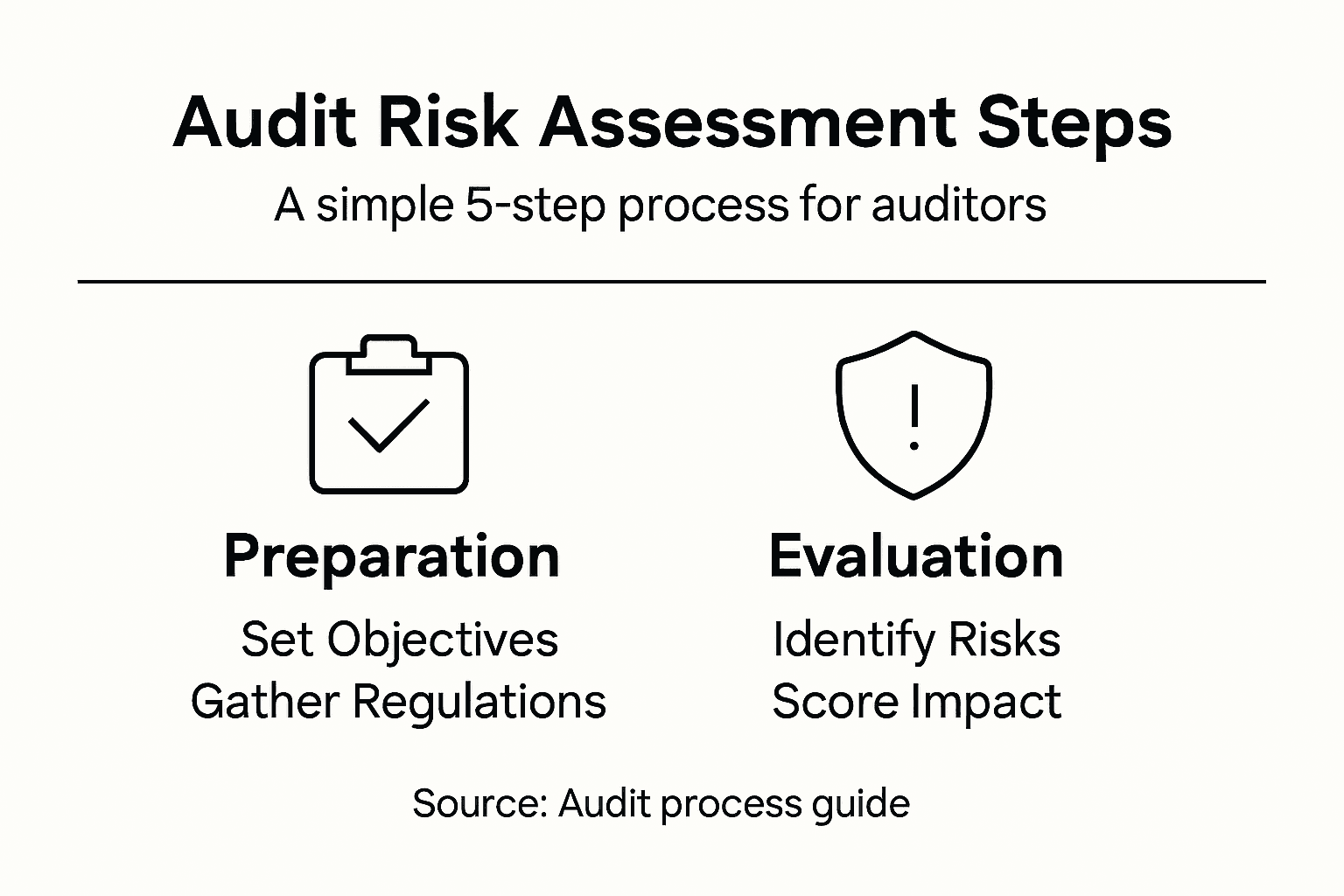
Pro tip: Develop a standardized risk assessment template that allows for consistent and repeatable evaluation across different organizational contexts.
Step 4: Develop response strategies for key risks
Developing effective response strategies transforms risk assessment from theoretical analysis into practical organizational protection. By formulating targeted risk mitigation actions, you create a proactive approach to managing potential vulnerabilities.
Auditors typically employ multiple response strategies for addressing organizational risks:
Risk mitigation: Implement controls to reduce likelihood or impact
Risk transfer: Shift potential consequences through insurance or contractual arrangements
Risk avoidance: Eliminate activities generating high-risk exposures
Risk acceptance: Acknowledge and monitor risks with limited intervention options
Continuous monitoring: Establish ongoing tracking mechanisms for risk developments
The strategic response process requires a comprehensive collaborative approach that involves engaging key stakeholders and management. This means developing nuanced recommendations that balance organizational objectives with practical risk management techniques. Professional auditors understand that effective response strategies are not one-size-fits-all solutions but tailored interventions designed to address specific organizational contexts.
Below is a summary of risk response strategies and when to use them:
Response Strategy | When Applied | Key Benefit |
Mitigation | Risk can be lowered | Reduces exposure or consequence |
Transfer | Risk can be outsourced or insured | Shifts risk burden to external parties |
Avoidance | Risk is too high or uncontrollable | Eliminates threats entirely |
Acceptance | Risk is minor or cost to address high | Allows focus on critical issues |
Continuous Monitoring | Risk landscape changes frequently | Enables timely detection of issues |
Exceptional risk response strategies convert potential threats into opportunities for organizational improvement.
Successful risk management demands a dynamic and adaptive approach that continuously reassesses and refines response mechanisms based on changing organizational landscapes and emerging risk indicators.
Pro tip: Create a standardized risk response template that allows for rapid and consistent strategic interventions across different organizational scenarios.
Step 5: Verify mitigation and document audit evidence
Verifying risk mitigation strategies and meticulously documenting audit evidence are critical final steps in the risk assessment process. Through comprehensive evidence collection techniques, you transform risk insights into actionable organizational accountability.
Auditors employ multiple techniques to validate and document mitigation efforts:
Control testing: Validate effectiveness of implemented risk controls
Re-performance procedures: Independently verify critical organizational processes
Substantive testing: Examine underlying transactions and documentation
Inquiry and confirmation: Interview key stakeholders about risk management
Documentation review: Analyze existing organizational records
The verification process requires a systematic and rigorous approach that goes beyond surface-level examination. Professional auditors understand that thorough documentation serves multiple purposes: supporting audit conclusions, facilitating future reviews, and providing transparency for regulatory oversight. This means collecting evidence that is not just comprehensive but also precise, relevant, and directly linked to identified risk areas.
Meticulous audit evidence transforms risk assessment from theoretical exercise to demonstrable organizational improvement.
Successful verification demands an objective, methodical approach that critically evaluates mitigation strategies while maintaining professional skepticism and commitment to transparency.
Pro tip: Create a standardized evidence tracking template that ensures consistent, comprehensive documentation across all audit engagements.
Enhance Your Risk Assessment Skills with Expert Training
Mastering risk assessment is a critical challenge for auditors aiming to navigate complex regulatory requirements and identify key organizational vulnerabilities. This article highlights essential concepts like defining audit objectives, categorizing risks, and verifying mitigation efforts. If you find managing these detailed steps overwhelming or want to ensure your assessments are fully compliant and actionable you need practical, expert-led education.
Take your auditing expertise further with professional education and training tailored for audit and compliance professionals. At Compliance Seminars, you will gain access to CPE courses and webinars designed to sharpen your skills on risk frameworks, internal controls, and regulatory standards. Start transforming complex risk into manageable strategies today by visiting Compliance Seminars and registering for live or online sessions that reflect the latest industry best practices.
Frequently Asked Questions
What are the key objectives of a risk assessment in an audit?
The key objectives of a risk assessment in an audit are to identify and evaluate potential risks that could impact the organization’s compliance and financial stability. Start by outlining specific goals aligned with regulatory requirements, then systematically categorize these risks to focus your assessment.
How can I categorize risks effectively during the audit process?
To categorize risks effectively, break them down into distinct classifications such as financial, operational, compliance, strategic, and reputational risks. Utilize a structured approach to analyze these categories, then maintain a dynamic risk register that can be regularly updated.
What steps should I take to evaluate the likelihood and impact of identified risks?
Begin by assigning quantitative scores to the probability of risk occurrence and qualitatively assessing the potential impacts on the organization. Develop a risk matrix to visualize these evaluations, and aim to complete this assessment within a week to prioritize your audit efforts.
How can I develop response strategies for critical risks?
To develop response strategies, consider methods such as risk mitigation, transfer, avoidance, or acceptance based on the nature of the risk. Collaborate with key stakeholders to tailor your response strategies that address the specific vulnerabilities identified in your assessment.
What methods should I use to verify mitigation strategies during an audit?
Use control testing, re-performance procedures, and documentation reviews to verify the effectiveness of your mitigation strategies. Ensure thorough documentation of all verification efforts to support your audit conclusions and enhance transparency during the assessment process.
Recommended
Comments