Why document internal controls: audit efficiency & compliance


Summary:
Proper internal control documentation ensures audit reliability and reduces remediation costs.
Regulatory standards like SOX, PCAOB, and the GAO mandate detailed, current control documentation.
High-quality documentation enables faster audits, better risk management, and operational improvement.
Even well-structured organizations can fail audit tests when their internal controls lack proper documentation. A control that exists in practice but not on paper is, from an auditor’s perspective, a control that cannot be relied upon. This creates real risk: findings, remediation costs, and reputational damage that no compliance officer wants to explain to a board. This guide covers what internal control documentation actually means, which regulations require it, how it drives operational efficiency, and where organizations most often go wrong. Whether you are preparing for a SOX 404 assessment or a GAO-based review, the principles here apply directly to your work.
Table of Contents
Key Takeaways
Point | Details |
Regulatory requirement | Documentation of internal controls is mandatory for SOX and GAO Green Book compliance. |
Audit efficiency | Well-documented controls reduce audit delays, sample sizes, and test disruptions. |
Better risk management | Documentation clarifies responsibilities, closing process gaps and lapses in accountability. |
Avoid common pitfalls | Update, clarify, and align documentation with accepted frameworks to pass audits and mitigate risks. |
What does it mean to document internal controls?
Internal control documentation is the formal, written record of how your organization manages risk, ensures accurate financial reporting, and maintains operational accountability. It goes well beyond keeping a policy manual on a shared drive. True documentation captures the design, implementation, and operating effectiveness of every relevant control, giving auditors and management a clear picture of what is supposed to happen and evidence that it actually does.
Documentation can take several forms, and the right format depends on the complexity of the process being documented:
Flowcharts: Visual representations of process steps, decision points, and control activities. Useful for complex, multi-step processes.
Narratives: Written descriptions of a process, explaining who performs each step, when, and under what conditions.
Checklists: Structured lists confirming that required steps were completed. Best for routine, repetitive controls.
Risk and control matrices (RCMs): Tables that map specific risks to the controls designed to mitigate them, often including control owners, frequency, and evidence requirements.
Each format serves a purpose. Many organizations use a combination, particularly for processes with both automated and manual components.
The GAO Green Book sets a clear standard: documentation of internal controls is required for effective design, implementation, and operating effectiveness. Principle 3 of the Green Book specifically requires that documentation communicate the “who, what, when, where, and why” of every control. That is not a bureaucratic checklist. It is a practical standard that ensures controls are repeatable and auditable.
Knowing how to document internal controls effectively also means understanding that documentation quality matters more than volume. A 40-page narrative that is vague and inconsistent is far less useful than a concise, well-structured RCM. Following compliance workflow best practices can help your team build documentation that is both efficient to maintain and reliable under scrutiny.
Pro Tip: Focus on clarity and completeness, not quantity. Vague documentation hinders auditors just as much as missing documentation does. If a reviewer cannot understand the control from the documentation alone, it needs to be rewritten.
Regulatory drivers: Why documentation is mandatory
Documentation is not optional for public companies or government entities. Multiple statutes and standards make it a legal and professional requirement, and auditors are trained to look for it.
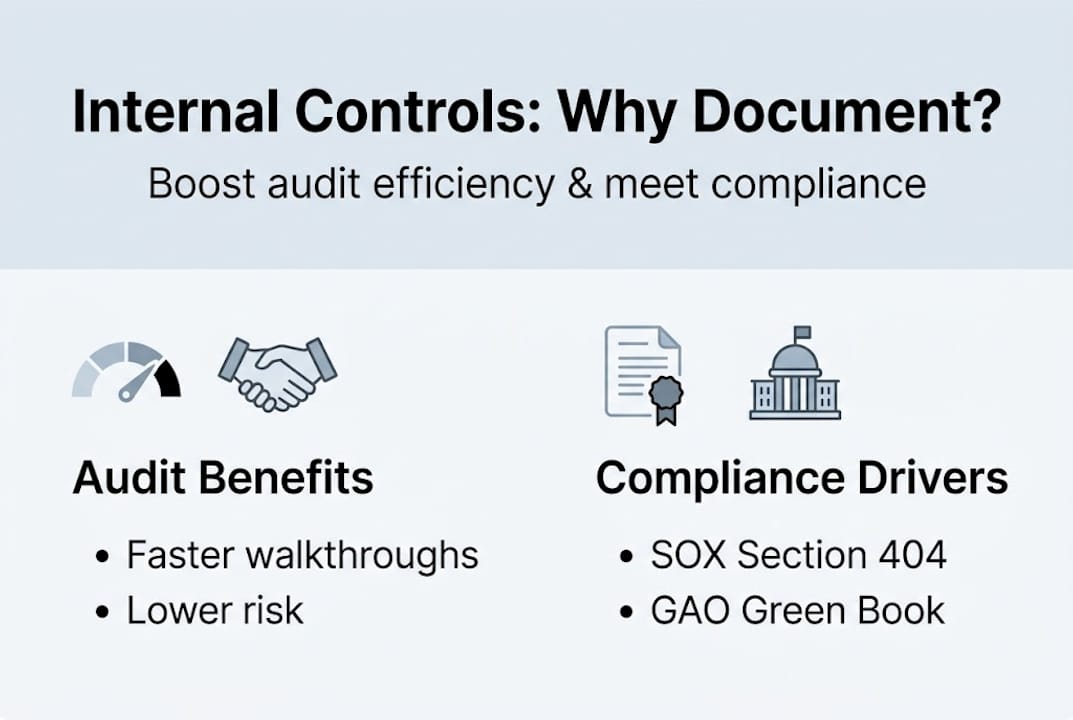
Sarbanes-Oxley Section 404 requires management of public companies to assess and report on the effectiveness of internal controls over financial reporting (ICFR). That assessment must be supported by documented evidence. You cannot assert that controls are effective without showing your work.
PCAOB AS 2201) mandates integrated audits requiring auditors to evaluate documented ICFR using recognized frameworks like COSO, necessitating management documentation for SOX 404 compliance. This standard places the documentation burden squarely on management, not the auditor.
The GAO Green Book Principle 3 requires documentation of the internal control system to communicate execution details including who, what, when, where, and why. For federal agencies and government contractors, this is the governing standard.
“An auditor cannot test what is not documented. Undocumented controls are, by default, untestable controls.”
Here is how the three major frameworks compare:
Framework | Applies to | Documentation requirement | Testing basis |
SOX Section 404 | Public companies | Management assessment of ICFR | PCAOB-integrated audit |
PCAOB AS 2201 | External auditors | Evaluate management’s documented controls | COSO or equivalent framework |
GAO Green Book | Federal agencies and grantees | Document who, what, when, where, why for all controls | GAO standards |
For SOX control documentation, the stakes are especially high. Deficiencies identified during an integrated audit can escalate to material weaknesses, triggering restatements, SEC scrutiny, and investor concern. The documentation you maintain today is the evidence that protects your organization tomorrow.
How effective documentation streamlines audits and improves performance
Beyond satisfying regulators, strong documentation pays operational dividends that many organizations underestimate. When auditors arrive, the quality of your documentation determines how quickly and smoothly the engagement proceeds.
Well-documented controls deliver measurable benefits:
Faster walkthroughs: Auditors can review documentation in advance, reducing the time spent on-site interviewing staff.
Smaller sample sizes: When controls are clearly documented and operating evidence is organized, auditors can often reduce the number of transactions they need to test.
Less disruption: Staff spend less time pulling records and answering questions when documentation is current and accessible.
Easier reliance: Auditors can re-perform or recalculate documented controls more efficiently, which supports their conclusions without extensive additional testing.
The GAO Green Book confirms that effective design, implementation, and operating effectiveness all depend on documentation being in place and current.
Consider how audit timelines differ based on documentation quality:
Documentation status | Walkthrough time | Sample size | Audit findings risk |
Fully documented, current | 1 to 2 days | Minimum | Low |
Partially documented | 3 to 5 days | Moderate | Medium |
Undocumented or outdated | 1 to 2 weeks | Maximum | High |
Beyond audit efficiency, documentation supports consistent personnel training and onboarding. When a control owner leaves, their replacement can pick up the process without a knowledge gap. That continuity is a risk management benefit that goes well beyond the audit room.

Using an internal control checklist helps teams stay organized and ensures nothing is overlooked during documentation reviews. For organizations focused on continuous improvement, evaluating internal controls on a regular cycle keeps documentation aligned with actual practice.
Pro Tip: Treat documentation as a living record. Outdated documentation is often more dangerous than no documentation, because it creates a false picture of your control environment and misleads both management and auditors.
Common pitfalls in documenting internal controls (and how to avoid them)
Even organizations that understand the importance of documentation frequently make mistakes that undermine its value. Recognizing these pitfalls is the first step toward avoiding them.
Over-complexity: Documentation that is too detailed or technical becomes unusable. Control owners stop referring to it, and auditors struggle to extract key information. Keep documentation precise and focused on what matters for the control to function.
Insufficient detail: The opposite problem is equally damaging. A narrative that says “management reviews the report” without specifying who, how often, what they look for, and what they do with exceptions fails the GAO Green Book standard. Every control needs enough detail to be repeatable by someone unfamiliar with the process.
Failure to update: Processes change. Personnel change. Systems change. Documentation that reflects last year’s process is misleading and can result in audit findings even when the current control is functioning properly. Establish a formal review cycle.
Overlooking informal controls: Many organizations rely on informal practices, verbal approvals, or undocumented reviews that actually serve as key controls. If these are not captured in documentation, they cannot be tested or relied upon. Identify and formalize them.
Lack of framework alignment: Documentation that does not map to COSO components or GAO Green Book principles makes it difficult for auditors to assess completeness. Align your documentation structure to the framework your organization uses.
Reviewing your internal audit checklist steps periodically helps catch gaps before auditors do. Looking at internal controls examples from comparable organizations can also reveal documentation approaches you may not have considered.
Pro Tip: Solicit periodic feedback from reviewers who are not involved in the day-to-day process. If they cannot follow your documentation, neither can an auditor.
Why documentation is your audit advantage (not just a requirement)
Most organizations treat internal control documentation as a compliance obligation, something to complete before the auditors arrive and then file away. That mindset costs real money and misses a significant opportunity.
Organizations with mature documentation practices use their records as a management tool, not just an audit artifact. When a process breaks down, well-maintained documentation tells you exactly where it failed and who was responsible. That is faster root cause analysis and faster remediation.
We have seen organizations walk into regulatory reviews with documentation so thorough and current that examiners reduced their testing scope within the first day. That is not luck. It is the result of treating documentation as a strategic asset. Understanding why internal controls matter at a leadership level is what separates organizations that merely pass audits from those that use the audit process to strengthen their operations.
“The organizations that benefit most from audits are the ones that arrive prepared. Documentation is how you prepare.”
The real payoff is audit readiness, improved training, and lasting risk mitigation. Documentation done well is not a burden. It is a competitive advantage.
Take the next step: Master internal control documentation
Understanding the principles of internal control documentation is one thing. Applying them under real audit conditions requires deeper expertise and practical skill. That is where structured professional education makes a difference.
At compliance-seminars.com, we offer internal auditor CPE webinars designed specifically for audit and compliance professionals who need practical, standards-based instruction. Our COSO compliance training covers the frameworks that underpin effective documentation and gives you the tools to build and maintain a control environment that holds up under scrutiny. Courses are NASBA-recognized and delivered by instructors with Big 4 experience who understand what auditors actually look for.
Frequently asked questions
Is documenting internal controls required by law?
Yes, standards like SOX Section 404 and the GAO Green Book require formal internal control documentation for compliance. PCAOB AS 2201) mandates documented controls for SOX compliance, making it a legal obligation for public companies.
What types of internal controls need documentation?
Both financial and operational controls should be documented, including preventative, detective, and corrective controls. The GAO Green Book Principle 3 covers all controls relevant to an organization’s objectives, not just financial reporting controls.
How often should control documentation be updated?
Review and update control documentation at least annually and whenever processes, personnel, systems, or risks change materially.
What happens during an audit if documentation is missing?
Auditors will report control deficiencies, and the organization may face findings, increased testing scope, and significant delays in completing the audit engagement.
How does documented internal control support SOX compliance?
SOX compliance requires management and auditors to reference and test documented internal controls over financial reporting. PCAOB AS 2201) relies on documented ICFR for compliance testing, making documentation the foundation of any successful SOX program.
Recommended
Understanding the role of compliance in wealth management
Comments