Regulatory Compliance Guide for Bank Officers: Step-by-Step Success


Regulatory expectations can shift overnight for banks in the United States, leaving compliance officers working overtime to keep policies current and gaps closed. Facing complex layers of federal rules and rapidly evolving best practices, you know that a systematic compliance assessment is your most reliable foundation for success. This article gives you practical, expert-driven steps to streamline regulatory reviews, strengthen your compliance framework, and empower your team with actionable guidance informed by industry-recognized CPE course standards.
Table of Contents
Quick Summary
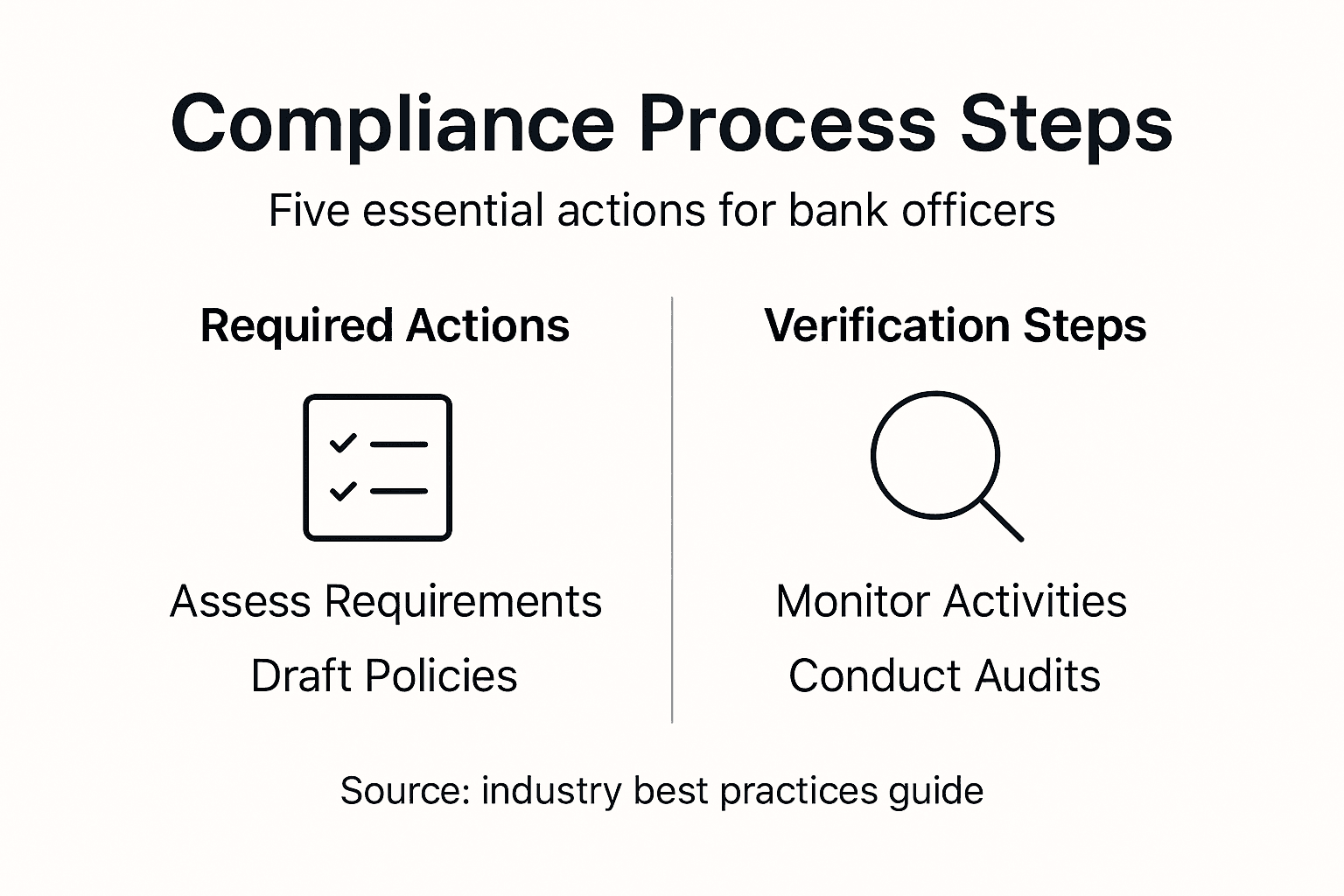
Essential Insight | Clear Explanation |
1. Conduct Thorough Compliance Review | Review all current regulatory guidelines and practices to identify compliance gaps appropriately. |
2. Create Robust Compliance Policies | Develop detailed policies that integrate governance and risk management to ensure regulatory integrity. |
3. Implement Effective Training Programs | Establish comprehensive training to empower employees with risk management and regulatory knowledge. |
4. Monitor Compliance Activities Proactively | Implement real-time monitoring and documentation systems to track adherence to regulations effectively. |
5. Regularly Conduct Audits and Tests | Use rigorous audit strategies to verify compliance effectiveness and identify areas for improvement. |
Step 1: Assess regulatory requirements for your institution
Successfully assessing your bank’s regulatory requirements demands a strategic, systematic approach. Your goal is to comprehensively map out the complex landscape of financial compliance standards that apply to your specific institution.
Start by conducting a thorough institutional compliance review. This means identifying all relevant regulatory frameworks, such as those outlined by the Basel 3.1 standards from regulatory bodies like the Bank of England. Your review should encompass multiple critical dimensions:
Capital adequacy requirements
Risk management protocols
Market risk assessments
Credit valuation procedures
Operational risk management
Key steps in this assessment process include:
Review all current regulatory guidelines
Map existing institutional practices
Identify potential compliance gaps
Document detailed findings
Prioritize necessary adjustments
A systematic approach prevents costly regulatory missteps and demonstrates proactive compliance management.
Engaging with professional compliance networks and attending specialized training can provide additional insights into interpreting and implementing these complex requirements. Some financial institutions also leverage external consultants to ensure comprehensive coverage.
Pro tip: Develop a dynamic compliance tracking system that allows real-time monitoring and rapid adaptation to emerging regulatory changes.
Step 2: Develop compliance policies and procedures
Developing robust compliance policies and procedures is a critical foundation for maintaining regulatory integrity in your financial institution. Your objective is to create a comprehensive framework that addresses both regulatory requirements and organizational risk management.
Begin by developing comprehensive compliance frameworks that integrate governance, risk, and operational controls. This process requires a strategic approach that encompasses multiple key elements:
Detailed documentation of regulatory expectations
Clear operational guidelines
Risk assessment protocols
Accountability mechanisms
Technology-enabled monitoring systems
Key steps in developing effective policies include:
Conduct thorough regulatory research
Map existing organizational practices
Identify potential compliance vulnerabilities
Draft precise policy language
Create implementation roadmaps
Establish monitoring and reporting mechanisms
Effective compliance policies transform regulatory challenges into strategic organizational strengths.
Successful policy development requires collaboration across departments, ensuring that compliance becomes an integrated organizational culture rather than a disconnected administrative function. This means engaging leadership, legal teams, and operational managers in creating policies that are both legally sound and practically implementable.

Pro tip: Design compliance policies with built-in flexibility that allows for rapid adaptation to emerging regulatory landscapes and technological changes.
Step 3: Implement internal controls and training
Implementing comprehensive internal controls and training programs is crucial for ensuring regulatory compliance and operational excellence in your banking institution. Your primary goal is to create a robust system that minimizes risk and empowers employees with the necessary knowledge and skills.
Begin by developing comprehensive compliance training programs that address key risk management and control strategies. This approach requires a multifaceted implementation focusing on several critical dimensions:
Preventive control mechanisms
Detective control strategies
Fraud prevention techniques
Regulatory compliance education
Continuous learning frameworks
Key steps in implementing effective internal controls include:
Conduct thorough risk assessments
Design targeted training modules
Establish clear accountability standards
Create monitoring and reporting systems
Develop ongoing education pathways
Implement regular performance evaluations
Internal controls are not just policies but a dynamic culture of organizational vigilance and professional responsibility.
Successful implementation requires creating a comprehensive compliance ecosystem that integrates training, technology, and organizational culture. This means developing interactive training programs that go beyond traditional instruction, incorporating real-world scenarios, case studies, and practical exercises that enhance understanding and retention.
Pro tip: Design training programs with adaptive learning technologies that personalize content based on individual employee knowledge gaps and learning styles.
Step 4: Monitor activities and document compliance
Monitoring and documenting compliance activities is a critical process that transforms regulatory requirements from abstract concepts into actionable, verifiable practices. Your primary objective is to establish a systematic approach that tracks, records, and validates your institution’s adherence to regulatory standards.
Implement comprehensive compliance monitoring systems that leverage advanced technologies and data analytics. This approach enables your organization to create a robust framework for continuous oversight and documentation:
Automated compliance tracking mechanisms
Real-time risk assessment tools
Standardized reporting protocols
Digital documentation platforms
Automated alert systems
Key steps in effective compliance monitoring include:
Establish baseline compliance metrics
Implement continuous monitoring technologies
Develop standardized documentation processes
Create regular reporting schedules
Design systematic review mechanisms
Build audit trail documentation
Effective monitoring transforms compliance from a checkbox exercise into a strategic organizational capability.
Successful implementation requires building a dynamic compliance documentation ecosystem that integrates technological solutions with human expertise. This means creating flexible systems that can adapt quickly to changing regulatory landscapes while maintaining meticulous records of all compliance activities.
Pro tip: Invest in compliance monitoring technologies that offer predictive analytics, enabling your organization to anticipate and mitigate potential regulatory risks before they escalate.
Step 5: Verify effectiveness through audits and tests
Verifying compliance effectiveness requires a comprehensive and systematic approach that goes beyond surface-level assessments. Your goal is to develop a rigorous audit strategy that critically evaluates your institution’s regulatory adherence and identifies potential improvement areas.
Conduct comprehensive compliance audit best practices that combine both internal and external evaluation methodologies. This multifaceted verification process should encompass several critical dimensions:
Detailed documentation reviews
Operational control testing
Risk assessment validation
Performance metric analysis
Independent third-party assessments
Key steps in effective compliance verification include:
Design comprehensive audit protocols
Develop standardized testing frameworks
Establish clear evaluation criteria
Implement periodic review mechanisms
Create remediation tracking systems
Generate actionable insights reports
Effective audits transform compliance from a reactive process to a proactive strategic advantage.
Successful verification requires building a dynamic and adaptive audit ecosystem that continuously evolves with changing regulatory landscapes. This means creating flexible assessment frameworks that can quickly identify and address potential compliance vulnerabilities while maintaining organizational agility.
Pro tip: Implement a continuous improvement cycle in your audit processes, treating each review as an opportunity to enhance your compliance strategy rather than merely checking boxes.
The table below summarizes common challenges in achieving regulatory compliance and effective solutions:
Compliance Challenge | Effective Solution | Business Benefit |
Complex regulations | Dynamic compliance tracking tools | Faster adaptation to new rules |
Siloed organizational culture | Cross-department collaboration | More effective compliance strategies |
Manual monitoring processes | Automated compliance technologies | Increased accuracy and efficiency |
Training consistency | Customizable, tech-enabled training | Improved employee understanding |
Reactive audit practices | Continuous audit improvement cycles | Early detection of vulnerabilities |
Here is a comparison of key compliance focus areas and their business impact:
Compliance Area | Primary Function | Potential Business Impact |
Capital Adequacy | Ensures sufficient financial buffer | Increases stability and trust |
Risk Management | Identifies and mitigates risks | Reduces losses and liabilities |
Internal Controls | Monitors and prevents violations | Enhances operational efficiency |
Policy Development | Aligns procedures with regulations | Supports sustainable growth |
Compliance Monitoring | Tracks adherence in real time | Enables proactive risk mitigation |
Audits and Testing | Validates compliance effectiveness | Drives continuous improvement |
Take Control of Your Bank’s Regulatory Compliance Journey Today
Navigating complex regulatory requirements and building effective compliance programs is a challenge every bank officer faces. This guide highlights key steps like assessing regulatory mandates, crafting strong policies, implementing internal controls, and verifying compliance through audits. If you want to move from uncertainty to confidence, mastering these essential concepts is critical to mitigating risk and protecting your institution’s reputation.
Unlock your full compliance potential by exploring expert-led Continuing Professional Education courses designed specifically for audit, compliance, and risk professionals. Gain practical skills on auditing standards, internal controls, and regulatory frameworks directly from industry experts. Act now to transform your regulatory challenges into a strategic advantage—visit Compliance Seminars and register for live webinars, in-person seminars, or custom training that empower you to lead your institution toward lasting regulatory success.
Frequently Asked Questions
What are the essential steps to assess regulatory requirements for my bank?
To assess regulatory requirements, start by conducting a thorough institutional compliance review. Identify relevant regulatory frameworks, document your findings, and prioritize any necessary adjustments within 30 days.
How can I develop effective compliance policies and procedures for my bank?
Begin by researching regulatory expectations and mapping existing practices. Draft clear policy language and establish monitoring mechanisms to implement robust compliance frameworks within 60 days.
What should I include in my internal controls and training programs?
Your internal controls and training programs should cover preventive and detective control strategies, fraud prevention techniques, and regulatory education. Design targeted training modules to enhance employee knowledge and conduct regular evaluations to ensure understanding.
How can I effectively monitor compliance activities in my bank?
Implement a compliance monitoring system that uses automated tracking mechanisms and real-time risk assessment tools. Develop standardized documentation processes to ensure transparent reporting and monitor progress on a weekly basis.
What are the best practices for conducting audits and verifying compliance effectiveness?
Follow comprehensive audit protocols that include operational control testing and independent assessments. Create clear evaluation criteria and implement periodic reviews to identify improvements, aiming for a complete audit cycle within 90 days.
How can I address common compliance challenges faced by banks?
To tackle common compliance challenges, invest in dynamic compliance tracking tools and encourage cross-department collaboration. Foster a culture of compliance and conduct regular training sessions to enhance overall organizational awareness.
Recommended
Comments