Internal audit charter: the key to strong governance


TL;DR:
An internal audit charter is a formal document defining audit purpose, authority, scope, and independence.
A strong, approved charter improves governance, reduces conflicts, and ensures audit credibility.
Regular review and active integration of the charter into organizational practices enhance audit effectiveness.
Most organizations treat their internal audit charter as a box to check, not a tool to use. That mindset is costly. When the charter lacks clarity on scope, authority, and independence, audit functions lose credibility and effectiveness before a single engagement begins. This guide breaks down what an internal audit charter actually is, why it carries real governance weight, and how to build one that does meaningful work inside your organization. Whether you are a chief audit executive, compliance officer, or a board member trying to understand your oversight responsibilities, the following sections will give you clear, actionable direction.
Table of Contents
Key Takeaways
Point | Details |
Defines audit authority | An internal audit charter formally establishes the scope and independence of the audit function. |
Strengthens governance | A well-crafted charter supports compliance, trust, and risk management across the organization. |
Guides daily audit work | The charter translates into practical guidelines that improve audit quality and reduce confusion. |
Needs regular updates | Reviewing the charter annually ensures it supports new regulations and evolving risks. |
What is an internal audit charter?
An internal audit charter is a formal document that establishes the purpose, authority, and responsibility of the internal audit function within an organization. It is not a policy manual. It is not a mission statement. Think of it as a constitutional document for your audit function: it defines what auditors can access, what they are accountable for, and who grants them the authority to do their work.
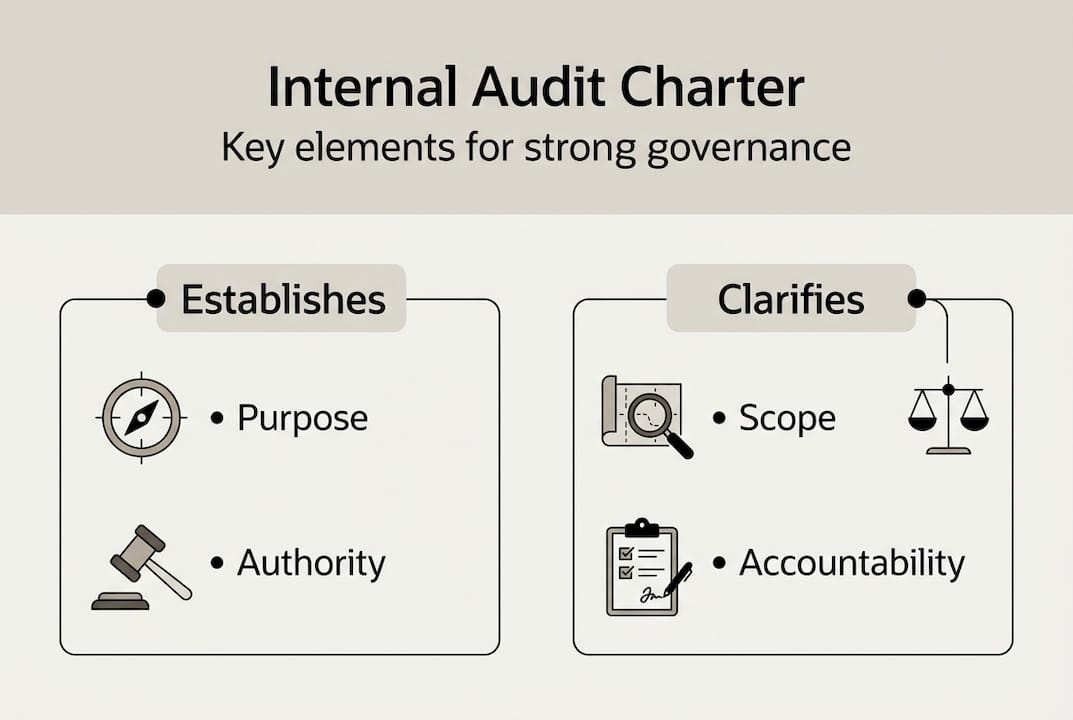
According to internal audit standards, an audit charter establishes the scope, authority, and accountability of the internal audit function. Without those three pillars clearly documented, audit teams operate in ambiguity, which creates real risk for the organization.
Understanding what internal audit is helps frame why the charter matters so much. Internal audit is an independent assurance and consulting activity. The charter is what makes that independence official and enforceable.
Here are the key elements a charter must define:
Purpose: The mission and objectives of the internal audit function
Authority: The right to access records, personnel, and assets relevant to audits
Scope: The range of activities and business units subject to audit review
Independence: Reporting lines that protect the audit function from undue influence
Accountability: Responsibilities to management, the board, and the audit committee
Standards: Reference to professional standards such as IIA, COSO, or SOX requirements
Charter element | What it defines |
Purpose | Why the audit function exists |
Authority | What auditors are empowered to do |
Scope | Which areas, units, or processes are auditable |
Independence | Who auditors report to and how conflicts are prevented |
Accountability | How findings are communicated and acted on |
“A charter without specifics on independence and reporting lines is little more than a document on a shelf. Specificity is what gives it teeth.”
The charter is distinct from individual audit plans or program-level policies. It is broader and more foundational, serving as the authority that makes all downstream audit work legitimate.
Why the internal audit charter matters for governance
With the foundation laid on what an audit charter is, it is critical to examine why this document plays a vital role in governance and compliance strategies.
A strong charter builds trust and transparency with stakeholders, including boards, regulators, and external auditors. When everyone knows what internal audit can and cannot do, governance becomes cleaner and conflicts become less frequent.

Consider what happens without one. Audit teams get pulled into engagements outside their defined scope. Management disputes whether auditors have the right to access certain records. The board receives inconsistent reporting because there is no agreed-upon standard. These are not hypothetical problems. They are documented patterns in organizations that skip or dilute their charters.
With vs. without a formal internal audit charter:
Area | With a charter | Without a charter |
Scope clarity | Clearly defined and board-approved | Constantly negotiated or disputed |
Auditor independence | Structurally protected | Vulnerable to management pressure |
Reporting | Standardized to audit committee | Ad hoc or inconsistent |
Risk coverage | Aligned with enterprise risk | Reactive and incomplete |
Regulatory readiness | Supported by documentation | Exposed to gaps during reviews |
Here is how a well-built charter reduces friction across the organization:
It removes ambiguity about what auditors can review, reducing pushback from operational teams
It establishes reporting lines that protect auditor objectivity
It gives the audit committee a clear basis for evaluating audit performance
It creates a documented foundation for regulatory examinations
Pro Tip: Use your internal audit checklist alongside the charter during scoping discussions. The two documents should align closely. If they do not, your charter may need an update.
The charter is also a key accountability tool for boards. When audit findings surface issues in controls or compliance, the charter is what establishes that the audit function had both the right and the responsibility to surface them.
Core contents of an effective internal audit charter
Understanding the importance leads naturally to the question: what should a well-crafted internal audit charter actually contain?
An effective charter details scope, independence, access, responsibilities, and reporting. Those five elements are the non-negotiables. Everything else is context-specific to your organization’s size, industry, and risk profile.
Here is a practical list of what to include:
Mission statement: One or two sentences defining why the audit function exists
Organizational positioning: Where internal audit sits in the org chart and who it reports to
Independence and objectivity provisions: Explicit language protecting auditors from management interference
Scope of audit activities: Types of engagements covered, including assurance and advisory work
Access rights: Auditors’ right to access personnel, records, systems, and physical locations
Professional standards: Specific reference to IIA Standards, COSO, or other applicable frameworks
Reporting responsibilities: How and to whom audit results are communicated
Charter review schedule: Frequency and process for updating the document
Charter clause | Weak version | Strong version |
Scope | “All business activities” | “Financial, operational, IT, and compliance activities across all business units” |
Access | “As needed” | “Unrestricted access to all records, systems, and personnel relevant to audits” |
Independence | “Auditors should be objective” | “Internal audit reports functionally to the audit committee, free from management override” |
Pro Tip: Avoid vague language like “all relevant areas” or “appropriate access.” Vagueness invites negotiation later. Be specific in every clause, especially those defining access and reporting.
One of the most common charter drafting mistakes is copying a template without adapting the scope language to your actual organizational structure. A generic charter creates a false sense of security. Tailor it through the lens of your internal audit process and the specific risks your organization faces.
Best practices for drafting, approving, and reviewing the charter
After dissecting core contents, the focus shifts to the right methods for drafting, gaining organizational buy-in, and sustaining a living charter.
Assemble a cross-functional drafting team. Include the chief audit executive, legal counsel, a senior compliance officer, and at least one board or audit committee representative. Each brings a different perspective on authority, risk, and governance obligations.
Standardize your language. Borrow terminology from IIA Standards and your relevant regulatory frameworks. Consistent language reduces the risk of misinterpretation and simplifies future reviews.
Secure board-level approval. The charter must be formally approved by the board or audit committee, not just acknowledged by management. That approval is what gives the document its authority.
Schedule annual reviews. Reviewing and updating the charter annually is essential for relevant and effective audits, especially as organizational structures, regulatory expectations, and risk landscapes shift.
Document every revision. Keep a version history with dates and the rationale for each change. This creates an audit trail for the charter itself.
Communicate changes broadly. When the charter is updated, notify all stakeholders, including business unit leaders, so expectations stay current.
“The charter is a living document. An organization that drafts it once and files it away is treating governance as a performance rather than a practice.”
Common pitfalls during charter review include failing to update scope after a merger or acquisition, not revisiting independence provisions when leadership changes, and skipping the review cycle during high-pressure audit seasons. Consistency here is everything. Your effective audit planning process should include a charter review as a standing agenda item each year.
How the internal audit charter connects to broader frameworks and risk management
Once the charter’s direct implementation is addressed, it is important to connect its impact to organization-wide frameworks and strategic risk navigation.
A well-structured charter helps align with internal audit frameworks and supports risk response across the enterprise. The IIA’s International Standards for the Professional Practice of Internal Auditing explicitly require a charter. COSO’s internal control framework also assumes a functioning and authorized audit activity. Without a charter, claims of framework alignment ring hollow.
Here is how the charter supports cross-functional governance:
IIA Standards compliance: The charter satisfies Standard 1000, which requires documented authority and purpose
COSO alignment: Demonstrates commitment to control environment components, particularly oversight responsibilities
SOX readiness: Supports Section 302 and 404 requirements by clarifying the role of internal audit in financial control testing
Cybersecurity audits: Defines the audit function’s authority to assess IT controls and internal audit in cybersecurity risk areas, which is increasingly important in 2026
Enterprise risk management: Connects audit scope to the organization’s risk register and strategic objectives
“When the charter explicitly covers cybersecurity and technology risks, it signals to regulators and boards that the organization takes modern threats seriously, not just traditional financial controls.”
In practice, the charter also makes cross-departmental collaboration smoother. When IT, finance, legal, and operations all understand what internal audit is authorized to do, cooperation replaces resistance. Turf battles over data access and engagement scope shrink when the charter makes the rules clear from the start.
Why most organizations underestimate the power of the internal audit charter
Here is an uncomfortable truth: most charters we see in practice are borrowed templates with a logo swapped at the top. They check the box for framework alignment, but they do not reflect how the organization actually operates. That disconnect is where real risk lives.
The charter’s true power is not in its existence. It is in its integration. When audit leadership actively references the charter during scoping discussions, when the audit committee uses it to evaluate annual performance, and when business units understand what it authorizes, the charter becomes part of organizational culture rather than a compliance artifact.
We have seen organizations where why internal audit matters becomes clear only after a regulatory examination flags a scope dispute or an undocumented reporting gap. That is a painful and avoidable lesson. The recommendation is straightforward: treat the charter as an active governance instrument. Reference it in every engagement kickoff. Review it with your audit committee before each annual planning cycle. Make it the first document a new auditor reads. When the charter is embedded in daily practice, it stops being shelfware and starts being the backbone of audit credibility.
Advance your internal audit expertise
Building a strong internal audit charter is a skill that benefits from structured, credentialed training. If you want to deepen your understanding of audit authority, independence requirements, and governance best practices, targeted education makes a measurable difference.
At compliance-seminars.com, we offer internal auditor CPE webinars specifically designed for professionals who need practical, standards-based instruction. Our internal auditing 101 course covers the foundational elements of audit charters, planning, and execution. You can also browse our full lineup of 2026 CPE events across multiple U.S. cities and live webinar formats. All training is NASBA-recognized and delivered by instructors with Big 4 experience.
Frequently asked questions
Who should approve the internal audit charter?
Board-level approval is critical for audit charter authority. Typically, the board of directors or audit committee holds final approval to ensure the function’s independence is formally recognized.
How often should the internal audit charter be reviewed?
The charter should be reviewed at least annually. Annual reviews keep the charter relevant as organizational structures, risks, and regulatory requirements evolve.
Is an internal audit charter required for compliance certifications?
Yes. Audit charters are required for IIA and COSO alignment, and most major compliance frameworks assume a formally documented audit authority is in place.
What risks exist without a formal internal audit charter?
Lack of a charter leads to audit and scope ambiguities, contested authority, and gaps in risk coverage that regulators and external auditors are likely to flag during examinations.
Recommended
Comments