How to prepare for CPE audits with confidence in 2026


Many auditors experience last-minute panic upon receiving a CPE audit notification, scrambling to locate certificates and verify documentation. The stress stems from treating audit readiness as a reactive task rather than an ongoing practice. This guide provides a structured, step-by-step approach to confidently meet 2026 CPE audit standards, transforming preparation from a source of anxiety into a manageable compliance routine.
Table of Contents
Key takeaways
Point | Details |
Understanding requirements | NASBA and state board standards guide proper documentation and retention policies. |
Organized documentation | Maintaining systematic records and conducting internal assessments reduces audit risks significantly. |
Technology leverage | Digital tools automate tracking, cut manual errors by 25%, and streamline audit readiness. |
Avoiding mistakes | Poor record-keeping causes 40% of audit failures; strict retention protocols prevent penalties. |
Success metrics | Preparation timelines, zero documentation gaps, and reduced findings measure audit readiness. |
Introduction to CPE audits and their importance
NASBA and state boards conduct CPE audits to verify that professionals maintain competency through continuing education. These audits protect public interest by ensuring CPAs, CIAs, and other certified professionals meet rigorous learning standards. State boards typically use random selection processes or flag accounts showing compliance irregularities.
Audit selection can happen annually or occur randomly throughout your licensing period. When selected, you receive notification requiring documentation submission within 30 to 90 days. The consequences of non-compliance extend beyond administrative headaches. Penalties include fines, license suspension, and professional reputation damage that can derail careers.
Many professionals mistakenly believe completing education hours guarantees audit success. That’s wrong. Failure to maintain original certificates and records causes 40% of audit non-compliance cases. Documentation quality matters as much as course completion.
Common audit triggers include:
Missing or incomplete learning objective documentation
Inconsistent tracking between self-reported hours and provider records
Expired or non-NASBA approved course certificates
Gaps in annual reconciliation records
Understanding the regulatory context helps you tailor preparation efforts to your specific jurisdiction. Each state board maintains unique requirements alongside NASBA’s baseline standards. Review NASBA CPE compliance requirements to identify jurisdiction-specific nuances that impact your documentation strategy.
The audit process isn’t designed to trap you. It exists to validate that professionals invest in continuous learning. When you treat compliance as an ongoing practice rather than a scramble after notification, audits become routine administrative tasks instead of career-threatening events.
Prerequisites for effective CPE audit preparation
Before diving into active preparation, establish foundational elements that support compliance success. You need more than good intentions; you need systems and knowledge in place.
Start by familiarizing yourself with current NASBA and state board CPE requirements. These standards evolve, and 2026 brought updates to reporting thresholds and documentation formats in several jurisdictions. Know your specific retention policies; most states require maintaining records for three to five years minimum.
Invest in reliable tracking systems. Whether you choose dedicated software or structured spreadsheets, your system must capture:
Course completion dates and certificate numbers
Provider names and NASBA registry identifiers
Learning objectives and field of study classifications
Credit hours by category (technical, ethics, behavioral)
Assemble your historical documentation now, not when audit notification arrives. Gather certificates from the past three to five years and verify each includes required elements like learning objectives and completion verification. Missing a single certificate from two years ago creates unnecessary audit complications.
Understand typical notification timelines. Boards usually provide 30 to 90 days for documentation submission. That sounds generous until you factor in gathering records from multiple providers, reconciling discrepancies, and compiling organized submission packages. Early preparation eliminates time pressure.
Develop awareness of document retention timeframes specific to your jurisdiction. Some states require five-year retention while others mandate three years. Err on the side of longer retention to avoid premature disposal of needed records. Consider developing a CPE training program that includes systematic retention protocols from the start.
Your prerequisites checklist should include current knowledge of NASBA CPE requirements, functioning tracking tools, complete historical records, timeline awareness, and clear retention policies. With these elements in place, you’re ready to execute structured preparation.
Step-by-step preparation process for CPE audits
Effective audit preparation follows a logical sequence that builds confidence and catches issues early. Here’s your actionable roadmap.
Verify current requirements. Review NASBA and your state board’s latest CPE standards. Regulations change, and 2026 updates may affect documentation formats or reporting categories. Check requirements quarterly to stay ahead of modifications.
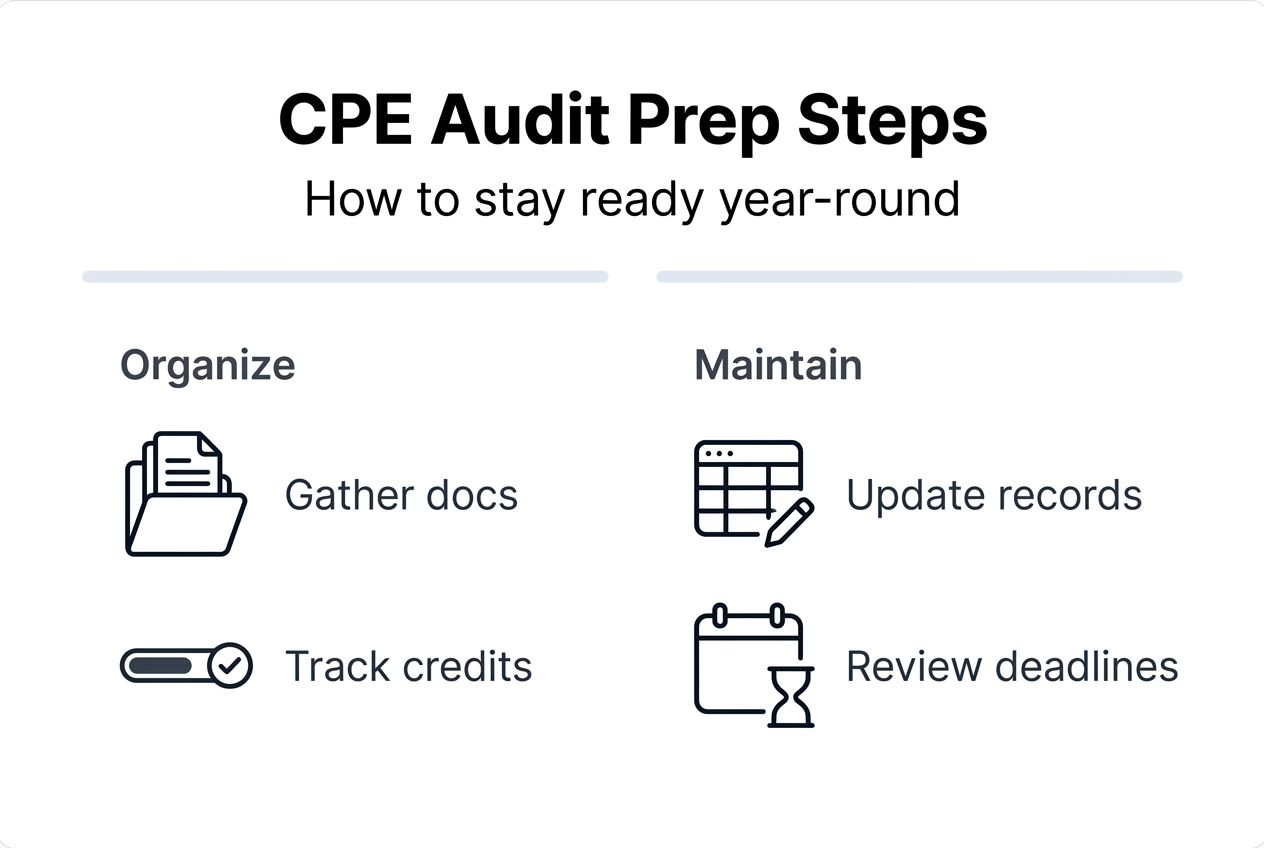
Collect and organize documentation. Gather all CPE certificates from your retention period. Create digital copies as backups. Organize by year, then by course date within each year. Ensure each certificate includes provider information, completion date, credit hours, and learning objectives.
Perform internal pre-audit assessment. Conduct your own audit simulation. Compare your tracking records against actual certificates. Identify gaps where documentation is missing or incomplete. Pre-audit self-assessment reduces audit failures by up to 30% because you catch problems while there’s time to fix them.
Reconcile tracking records annually. Don’t wait for audit notification to discover discrepancies. Each year-end, reconcile your self-reported hours against provider records and certificates. Contact providers immediately if records don’t match to secure corrected documentation.
Train your audit team. If you manage compliance for multiple professionals, train your team on documentation standards and submission procedures. Regular training sessions ensure everyone understands requirements and follows consistent processes.
Maintain ongoing updates. Treat audit readiness as continuous, not episodic. File certificates immediately upon course completion. Update tracking systems in real time. Monitor regulatory changes monthly through NASBA alerts and state board communications.
Pro Tip: Create a dedicated email folder for CPE-related communications. Filter all course confirmations, certificates, and provider emails into this folder automatically. When audit time comes, you have a centralized communication archive that supplements your certificate files.
This sequential approach transforms audit preparation from an overwhelming task into manageable steps. By following CPE training program development best practices, you build systems that support not just individual compliance but organization-wide readiness.
The key is consistency. Execute these steps throughout the year, not just when facing audit notification. Your future self will thank you for the discipline.
Common mistakes and how to avoid them
Even diligent professionals make predictable errors that jeopardize audit success. Recognize these pitfalls and implement fixes now.
Failing to retain original or verifiable certificates is the most damaging mistake. Some professionals assume provider records suffice or that self-reporting provides adequate documentation. Wrong. State boards require you to produce certificates showing completion verification. Without originals or certified copies, you can’t prove completion regardless of actual coursework.
Inconsistent or missing annual reconciliation elevates audit risk significantly. Many auditors track hours sporadically, discovering discrepancies only when facing submission deadlines. Annual reconciliation catches errors while you can still contact providers for corrections or locate missing documentation.
Relying solely on manual tracking invites human error. Spreadsheets with manual data entry miss courses, transpose credit hours, or lose files through device failures. Manual systems lack redundancy and real-time verification.
Ignoring NASBA and state board updates causes non-compliance through outdated practices. Requirements evolve regarding approved providers, acceptable course formats, and documentation standards. What worked last cycle may not meet current standards.
Implement these fixes:
Establish strict document retention policies with digital backup systems
Schedule annual reconciliation as a recurring calendar event
Transition to digital tracking tools that automate record-keeping
Subscribe to NASBA and state board alerts for regulatory updates
Create redundant storage: cloud backup plus physical certificate binders
Pro Tip: When completing any CPE course, immediately download the certificate to three locations: your tracking software, a dedicated cloud folder, and a local device backup. This triple redundancy prevents the common “I took the course but can’t find the certificate” crisis.
Avoiding CPE audit mistakes requires proactive systems, not reactive scrambling. Build habits that make compliance automatic rather than stressful.
Technology and tools to streamline CPE audit preparation
Digital tools transform audit preparation from paper-intensive chaos into streamlined efficiency. Understanding options helps you choose solutions matching your needs and budget.

Dedicated CPE management software automates document collection, tracks credit hours by category, and generates audit-ready reports instantly. These platforms integrate with NASBA registries to verify provider approvals and flag non-qualifying courses before you invest time.
Manual record-keeping requires hours of filing, reconciling, and report generation. Each certificate needs manual entry, creating opportunities for data entry errors. When audit notification arrives, you spend days compiling submissions that software generates in minutes.
Digital tools improve audit preparation efficiency by automating workflows and reducing manual errors by approximately 25%. Real-time tracking provides instant visibility into your compliance status, eliminating guesswork about whether you’ve met requirements.
Key benefits of digital solutions include:
Automated certificate uploads and data extraction
Real-time compliance dashboards showing progress toward requirements
Automated alerts for expiring credits or upcoming deadlines
One-click audit report generation
Cloud storage with automatic backups
Tradeoffs exist. Quality CPE audit management software requires subscription fees ranging from $50 to $500 annually depending on features and user count. Teams need training time to adopt new systems effectively. However, the time savings and error reduction typically justify costs within the first audit cycle.
Method | Efficiency | Error Rate | Cost | Best For |
Manual tracking | Low | High | Free | Individual with few courses |
Spreadsheet systems | Medium | Medium | Free | Small teams with basic needs |
Dedicated CPE software | High | Low | $50-$500/year | Professionals managing multiple licenses |
Enterprise platforms | Very High | Very Low | $1000+/year | Large organizations |
For CPE management software case study examples, review how firms reduced audit preparation time from 40 hours to 8 hours annually after implementing digital solutions. The return on investment becomes clear when you value professional time appropriately.
Choose tools matching your complexity level. Individual practitioners may thrive with mid-tier solutions while large audit departments benefit from enterprise platforms offering team collaboration and centralized compliance monitoring.
Expected outcomes and metrics of successful CPE audit preparation
How do you measure audit readiness success? Concrete metrics help you evaluate preparation effectiveness and identify improvement opportunities.
Typical preparation timelines range from four to eight weeks for professionals maintaining organized records. If you’re starting from scratch or addressing historical gaps, allow 12 to 16 weeks. These timelines assume part-time effort alongside regular job responsibilities.
Primary success indicators include:
Zero critical documentation gaps means every required certificate is accessible, complete, and verifiable. You can produce evidence for 100% of claimed CPE hours without scrambling or making excuses.
Complete record retention across your jurisdiction’s required timeframe demonstrates systematic compliance. If your state mandates five-year retention, you maintain organized records covering that entire period.
Reduction in non-compliance findings by at least 20% compared to previous audit cycles shows process improvement. First-time auditees should target zero findings as the benchmark.
Fewer audit follow-ups signal comprehensive initial submissions. When boards request additional documentation or clarification, it indicates submission gaps. Quality preparation minimizes these requests.
Metric | Target | Measurement Method |
Documentation completeness | 100% | All claimed hours have supporting certificates |
Preparation timeline | 4-8 weeks | Time from audit notification to submission |
Audit findings | Zero | Number of compliance issues identified |
Follow-up requests | Zero | Additional documentation requests from board |
Year-over-year improvement | 20% reduction | Fewer findings compared to previous cycle |
Continuous readiness represents the ultimate success metric. Rather than preparing only when notified, you maintain audit-ready status year-round. This mindset shift eliminates preparation stress entirely because your documentation stays current automatically.
Track these metrics across audit cycles to identify trends. Improving scores validate your preparation investments. Stagnant or declining metrics signal the need for process refinements or additional training.
Remember that perfect audit outcomes stem from imperfect but consistent daily habits. Small actions like immediate certificate filing compound into significant compliance advantages over time.
Summary and best practices for ongoing CPE audit readiness
Transforming audit preparation from reactive scrambling to proactive readiness requires adopting continuous compliance practices. Let’s consolidate the essential elements.
Maintain ongoing documentation with immediate updates. File certificates within 24 hours of course completion. Update tracking systems in real time rather than batching entries quarterly or annually. This discipline eliminates the accumulation of documentation backlogs that create audit preparation stress.
Conduct periodic internal audit simulations to identify gaps early. Schedule quarterly self-audits where you verify documentation completeness and reconcile tracking records against certificates. These simulations catch issues while you have time to secure corrected documentation from providers.
Regularly monitor NASBA and state board regulatory updates through official channels. Subscribe to email alerts, review board websites monthly, and attend compliance webinars covering regulatory changes. Proactive monitoring prevents the common mistake of using outdated requirements.
Key ongoing practices include:
Immediate certificate filing and backup creation
Quarterly internal compliance reviews
Monthly regulatory update monitoring
Annual comprehensive reconciliation
Periodic team training on updated procedures
Train audit teams on new compliance policies and procedures as they emerge. Don’t assume everyone automatically adopts new requirements. Formal training sessions ensure consistent understanding and application across your organization.
Adopt a proactive mindset treating audit readiness as a continuous cycle rather than an episodic crisis. This mental shift transforms your relationship with compliance from adversarial to collaborative. You’re not trying to “pass” audits; you’re demonstrating ongoing professional development commitment.
Continuous CPE audit readiness becomes automatic when you build systems supporting daily compliance habits. The goal isn’t perfection but consistent progress toward organized documentation and accurate record-keeping.
Your audit preparation success ultimately reflects your commitment to professional excellence. View CPE requirements not as burdensome obligations but as opportunities to expand expertise and advance your career. This perspective makes compliance feel purposeful rather than punitive.
Enhance your CPE audit skills with expert training
Ready to take your audit preparation and compliance skills to the next level? Our comprehensive training programs help you master the documentation strategies and regulatory knowledge covered in this guide.
Explore our 2026 CPE event calendar featuring in-person seminars across multiple U.S. cities. These intensive sessions provide hands-on practice with audit documentation techniques and direct interaction with industry experts.
Our internal auditor CPE webinars deliver focused training on compliance standards, risk management, and audit best practices. Each webinar awards CPE credits while strengthening your preparation capabilities.
Join our live CPE webinars to stay current on evolving NASBA requirements and documentation standards. These sessions feature real-world case studies and practical tools you can implement immediately.
Frequently asked questions
What is the typical notification period for a CPE audit?
Most state boards provide 30 to 90 days’ notice after selecting you for audit. This window allows time to gather documentation and compile your submission package. Some jurisdictions offer shorter notification periods, so maintain audit-ready records year-round to avoid time pressure.
How long should I retain my CPE documentation?
Retention requirements vary by jurisdiction but typically range from three to five years. Check your specific state board’s policy and retain records for the longer period if you hold licenses in multiple states. Consider keeping documentation indefinitely using digital storage to eliminate disposal decisions.
Can I prepare for a CPE audit if I missed some certificates?
Yes, but act quickly. Contact course providers immediately to request duplicate certificates or completion verification letters. Many providers maintain records for several years and can reissue documentation. If providers no longer exist or records are unavailable, document your diligent efforts to obtain proof and explain gaps transparently in your submission.
What digital tools are recommended for small audit teams?
Small teams benefit from mid-tier CPE management software offering essential features without enterprise complexity. Look for platforms with automated certificate uploads, compliance dashboards, and audit report generation. Prices typically range from $100 to $300 annually for small team licenses, providing significant time savings over manual tracking.
How often should internal pre-audit assessments be conducted?
Conduct comprehensive internal assessments quarterly to catch documentation gaps and reconciliation errors early. Annual assessments at minimum ensure you maintain audit readiness, but quarterly reviews provide more frequent opportunities to address issues before they compound. Schedule assessments as recurring calendar events to ensure consistency.
Recommended
Comments