Cybersecurity Compliance Steps: A Proven Implementation Guide


TL;DR:
Skipping a single step in cybersecurity compliance can lead to costly breaches and regulatory penalties that are preventable with a structured process. The NIST Risk Management Framework guides organizations through seven continuous, interconnected steps essential for ongoing, evidence-based risk management. Maintaining discipline across these phases and leveraging automation for monitoring ensures effective, durable cybersecurity compliance.
Skipping a single step in your cybersecurity compliance process can cost far more than a fine. Breaches traced to unpatched controls, audit failures caused by missing documentation, and regulatory penalties from incomplete risk assessments are all preventable when you follow a structured, repeatable methodology. This guide walks compliance and risk management professionals through every critical phase of a proven compliance process, from initial preparation through continuous monitoring, using the NIST Risk Management Framework as the backbone. You will leave with a practical sequence you can put to work immediately, not just a theory.
Table of Contents
Key Takeaways
Point | Details |
Follow a proven process | The NIST RMF’s seven steps provide a reliable and repeatable road map for cybersecurity compliance. |
Operationalize, don’t just check | Success means embedding compliance into daily operations, not completing one-off checklists. |
Prepare with the right tools | Lining up policies, teams, and evidence early smooths every step of the compliance journey. |
Measure and monitor | Continuous monitoring and outcome tracking ensure long-term compliance effectiveness. |
Avoid common pitfalls | Recognizing where teams frequently stumble helps you proactively address gaps before they grow. |
Understanding the cybersecurity compliance process
Let’s start by understanding the foundational methodology behind effective compliance.
Regulations do not ask you to fill out a form and move on. They expect you to demonstrate an ongoing, evidence-based program that shows your organization identifies, manages, and responds to risk systematically. The NIST Risk Management Framework, documented in NIST SP 800-37 Rev. 2, is the most widely adopted approach for achieving this. It establishes a 7-step cycle: Prepare, Categorize, Select, Implement, Assess, Authorize, and Monitor.
Think of the RMF less like a checklist and more like a continuous loop. Each cycle through it strengthens your controls, refines your documentation, and builds the institutional knowledge your team needs to respond confidently when auditors arrive or incidents occur. For a deeper orientation to frameworks and practical steps, it helps to understand how the RMF connects to other standards like CMMC and ISO 27001.
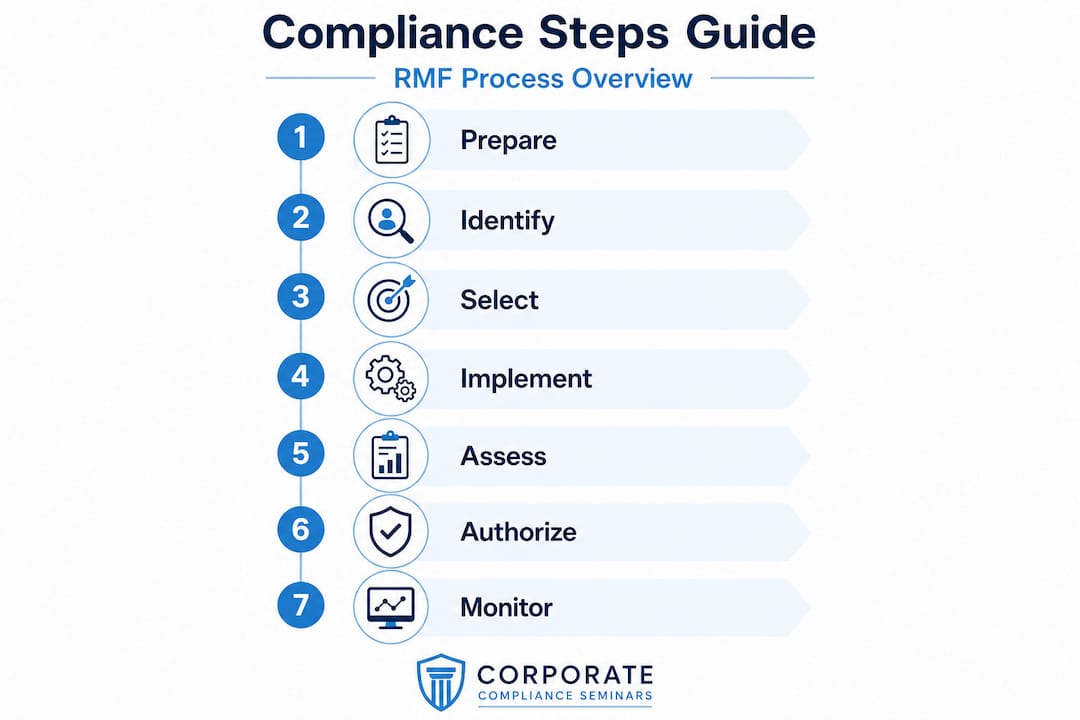
Here is a quick summary of all seven steps:
Step | Name | Core Purpose |
1 | Prepare | Establish context, roles, and risk strategy |
2 | Categorize | Classify systems by impact level |
3 | Select | Choose appropriate controls from NIST SP 800-53 |
4 | Implement | Deploy controls and document the environment |
5 | Assess | Test whether controls are effective |
6 | Authorize | Obtain senior-level risk acceptance |
7 | Monitor | Track controls and changes continuously |
“The NIST RMF is not a one-time project. It is a living process designed to keep pace with evolving threats, technology changes, and regulatory expectations.”
Each of these seven steps has a specific owner, a deliverable, and a set of evidence requirements. When teams understand the intent behind each phase, compliance stops feeling like bureaucratic overhead and starts functioning as genuine risk reduction.
Breaking down the seven essential steps
Now that the full process is clear, we’ll break down what each step actually looks like when put into practice.
To operationalize compliance, you need to translate risk into selected controls, implement them, assess their effectiveness, and make a formal risk-based authorization decision before moving into continuous monitoring. Here is what that looks like for each step.
Prepare. This is where many programs fail before they begin. Preparation means establishing your risk management strategy, identifying key stakeholders, and defining the boundaries of what you are protecting. The CISO, compliance officer, and senior leadership should all be involved here. Skipping this step leads to poorly scoped assessments and wasted effort.
Categorize. Every information system must be classified by the potential impact of a breach on confidentiality, integrity, and availability. Use FIPS 199 categories: low, moderate, or high. This classification drives every subsequent decision, so getting it wrong ripples through the entire process. For risk management best practices, document the rationale behind each categorization decision, not just the outcome.
Select. Based on your impact categorization, you choose the appropriate baseline of controls from NIST SP 800-53. A high-impact system will require a much larger and more robust control set than a low-impact one. Tailor the baseline thoughtfully, and document every tailoring decision with a clear justification.
Implement. This is the operational phase where IT teams, system owners, and control owners deploy the selected controls into the live environment. Documentation is critical here. A system security plan (SSP) captures what controls are in place, how they are configured, and who is responsible for maintaining them. Weak documentation at this stage is the single biggest source of audit findings.
Assess. An independent assessor, either internal audit or a third party, evaluates whether each control is implemented correctly and functioning as intended. This is not a rubber stamp. Effective assessment includes interviews, observation, and evidence review. The cybersecurity auditing workflow follows a structured testing approach that ensures thoroughness without scope creep.
Authorize. A senior official, typically an Authorizing Official (AO), reviews the assessment findings, weighs residual risk against mission needs, and issues a formal Authorization to Operate (ATO) or denial. This step places accountability at the right level and creates a documented risk acceptance decision that auditors expect to see.
Monitor. Compliance does not end at authorization. Your team must continuously track control effectiveness, respond to system changes, and report on security status. Treat monitoring as the engine that keeps authorization current.
Pro Tip: When documenting the Implement step, use a version-controlled SSP template that links each control directly to the evidence artifact, such as a screenshot, policy document, or configuration export. This makes the Assess phase dramatically faster and reduces back-and-forth with assessors.
Tools, controls, and documentation: What you need to get started
Understanding the steps is key, but being prepared with the right resources and tools is equally critical for smooth execution.
A common pattern across leading compliance frameworks is risk scoping, control selection, implementation, structured assessment, formal approval, and continuous monitoring rather than one-time checklist completion. Before you launch the RMF cycle, assemble the following resources.
Requirement | RMF Step | Example Tools or Artifacts |
Risk management strategy | Prepare | Policy documents, risk register templates |
System boundary documentation | Categorize | Network diagrams, data flow maps |
Control baseline selection | Select | NIST SP 800-53 catalog, tailoring worksheets |
System security plan | Implement | SSP templates, configuration records |
Assessment report | Assess | Security assessment report (SAR), test scripts |
Risk acceptance memo | Authorize | ATO letter, plan of action and milestones (POA&M) |
Monitoring dashboards | Monitor | SIEM tools, vulnerability scanners, log aggregators |
Internal audit’s role in this process is often underestimated. Audit teams bring an independent perspective to both the Assess and Monitor phases, and their involvement creates the separation of duties that regulators look for.
Beyond tools, your program needs these key control families addressed from day one:
Access control: Who can reach what data, under what conditions, and with what logging.
Configuration management: How systems are built, changed, and patched over time.
Incident response: How your team detects, contains, and reports security events.
Audit and accountability: What logs are generated, how long they are retained, and who reviews them.
Risk assessment: How frequently you evaluate threats to your systems and data.
Contingency planning: What happens when a system goes down or a breach occurs.
System and communications protection: How data in transit and at rest is encrypted and protected.
Good compliance monitoring best practices depend on having these control families documented and assigned to specific owners before the RMF cycle begins. Ownership without documentation is just hope.
Common pitfalls and troubleshooting tips
Even well-prepared teams stumble. Here are the most common barriers and how to sidestep them.
The NIST RMF step intents are precise: categorize impact, select controls, implement and document, assess operating effectiveness, obtain senior authorization, and monitor continuously. Where teams go wrong is treating these as sequential boxes to check once rather than as phases to revisit regularly.
Here are the most frequent failure points:
Treating categorization as permanent. Systems change. New data types are added, integrations are built, and threat landscapes shift. Categorization should be reviewed at least annually or after significant system changes.
Weak or missing evidence. A control that is implemented but undocumented might as well not exist during an audit. Evidence management requires discipline: version control, named custodians, and clear retention schedules.
Vague risk acceptance decisions. ATO letters that do not clearly articulate the residual risks being accepted are a liability. The authorizing official needs enough detail to make a meaningful decision, not a summary that papers over concerns.
Treating the POA&M as a parking lot. Plans of action and milestones should drive remediation, not store findings indefinitely. If items sit in a POA&M for multiple cycles without progress, your program has a governance problem.
Skipping the Monitor step. This is the single most common reason programs fail at their next audit. If your authorization is two years old and nothing has been continuously tracked since, your control environment is unverifiable.
Pro Tip: Automate what you can in the Monitor phase. Vulnerability scanners, SIEM alert rules, and configuration compliance tools can generate continuous evidence without manual effort. Schedule monthly automated reports that feed directly into your monitoring log. This keeps your authorization current and gives auditors a clean audit trail.
Warning: Organizations that treat monitoring as an annual event, rather than a continuous process, almost always discover control failures during audits rather than before them. That timing is far more costly.
Reviewing cybersecurity tips for auditors and the broader cybersecurity compliance frameworks landscape will help you build troubleshooting instincts grounded in what actually fails in practice.
Measuring success: How to tell your compliance program works
With the steps and challenges in mind, how do you actually confirm your efforts paid off?

Effective controls are in place, operating as intended, and continuously monitored for risk. That is the standard. Measuring whether your program meets it requires tying specific, observable outcomes to each RMF phase.
RMF Step | Measurable Success Indicator |
Prepare | Risk strategy documented and approved by leadership |
Categorize | All systems classified with documented rationale |
Select | Tailored control baselines approved and version-controlled |
Implement | SSP complete with evidence artifacts for each control |
Assess | SAR issued with findings rated and tracked |
Authorize | ATO in place with residual risks explicitly accepted |
Monitor | Monthly monitoring reports generated with zero lapsed controls |
Beyond the table, here are quick indicators that compliance is genuinely embedded in your organization rather than just performed for auditors:
Staff can explain their control responsibilities without referencing a document.
Audit findings are decreasing across successive assessment cycles.
Incidents are detected internally before being reported by third parties.
New systems enter the RMF automatically rather than being discovered post-deployment.
Leadership reviews security posture as part of regular business reporting, not as a separate compliance event.
POA&M items are resolved within agreed timeframes, not deferred indefinitely.
Tracking measuring continuous compliance over time, rather than at single audit points, is the only way to build a credible story for regulators and executive leadership alike.
The real secret: Continuous compliance beats checklists every time
As you reflect on your compliance strategy, here is what really makes programs last, from a practitioner’s view.
Most compliance failures I have seen share one root cause: the team treated the process as a project with an end date rather than an ongoing operational discipline. They sprint to an audit, pass, and then coast until the next one. By the time the next cycle arrives, the control environment has drifted, documentation has aged, and the findings are worse than the last time. It is a predictable, avoidable pattern.
The organizations that consistently perform well in audits and sustain low incident rates do something different. They run the RMF cycle as a living engine. The Monitor step feeds back into Prepare for the next cycle. Control owners receive regular feedback on their performance metrics, not just a report at year-end. Ownership is clear, specific, and reinforced through operational processes rather than left to a compliance team to manage in isolation.
There is also a cultural dimension that checklists miss entirely. When employees understand why a control exists, they maintain it more reliably than when they see it as administrative overhead. Building that understanding requires investment in communication, training, and leadership visibility around security priorities.
True compliance maturity looks like this: your team is not anxious before an audit because the audit captures what they already know. Evidence is current. Monitoring is automatic. Decisions are documented. The proven frameworks for ongoing compliance all point to this same conclusion: process discipline, not periodic sprints, is what separates durable programs from fragile ones.
Advance your compliance expertise with practical training
Ready to take your expertise further? Deepen your mastery with expert-led training and community insights.
The steps and frameworks covered in this guide form the foundation of effective compliance, but applying them under real-world conditions requires hands-on, expert-led instruction. Our Information Technology CPE training offers NASBA-recognized courses designed for compliance officers, risk managers, and auditors who need practical, credentialed skills, not just theory.
For professionals focused specifically on regulatory risk, our cybersecurity CPE events bring together practitioners and instructors with Big 4 and regulatory backgrounds. If you are ready to go deeper on program assessment and audit execution, the course on auditing cybersecurity programs provides a structured, step-by-step approach to evaluating and reporting on compliance programs across frameworks. Invest in skills that carry both credential value and direct application to your next audit cycle.
Frequently asked questions
What is the first step for cybersecurity compliance according to NIST?
Preparation is the NIST RMF’s first step, requiring organizations to establish their risk context, define roles, and set their risk management strategy before categorizing systems or selecting controls.
Why is continuous monitoring important in cybersecurity compliance?
Continuous monitoring ensures controls stay effective as systems change and new threats emerge, allowing teams to detect risks early rather than discovering failures during a scheduled audit.
Which compliance frameworks use a “repeatable process” similar to NIST RMF?
Most leading frameworks follow the same repeatable compliance engine: risk scoping, control selection, implementation, assessment, formal approval, and continuous monitoring, including ISO 27001 and CMMC.
How do you know your compliance program is working?
Look for fewer audit findings across successive cycles, lower incident rates, and control assessments consistently showing controls are in place and operating as intended, not just documented.
Can cybersecurity compliance steps be automated?
Monitoring tasks, evidence collection, and vulnerability scanning can be automated effectively, but risk categorization, control authorization, and risk acceptance decisions require informed human judgment and accountability.
Recommended
Comments